
Forecasting Fallacies
When trends betray you...


You get what you expect to get—whether that is a fear or a fortune.
For the first few years of my career, I did traffic impact studies. When a developer wanted to build something new, an engineer would need to forecast what traffic the project would generate and how that would impact the system. It was the principle of:
“You break it, you bought it.”
Any future failures would need to be remediated by the developer.
Unfortunately, this was never a Current + Project = Future effort. We were required to assume a background growth rate. That meant we needed to look at the historical volumes on every road around the project to identify how fast they were growing and then grow the current volume into the future before we added in the traffic from the project. On the surface, that seems like a reasonable way to make sure you never have problems in your roadway network. (Watch me put my Dr. Phil hat back on:)
How’s that working for you?
Let me give you a silly example of why that doesn’t work:
The Weatherman
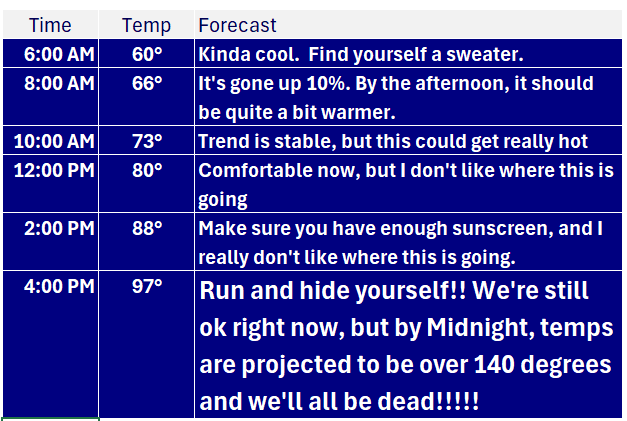
So why is the weatherman so freaked out? The growth rate is only 5 percent per hour!
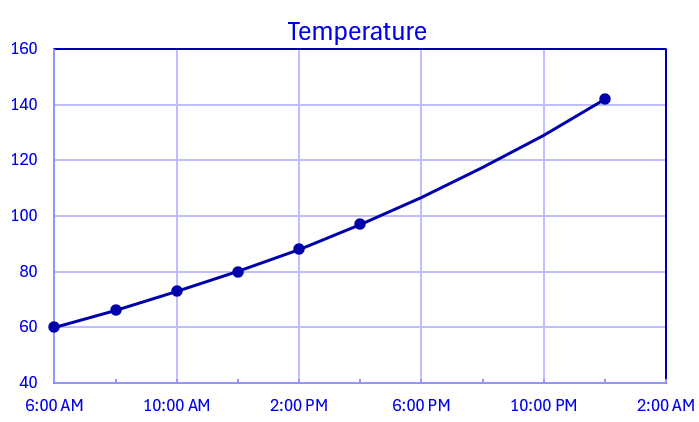
Few systems maintain trends indefinitely—even a trend as stable as this one. What goes up, must come down. Capacity constrains systems, and they eventually come into equilibrium.
It didn’t matter how often I argued the point, the pushback was always the same: A capacity constraint means that we aren’t satisfying the latent demand. What they were implying is that communities would be leaving money on the table—because movement equals economic prosperity. They could force the developer to pay or build the roadway they needed and it felt like a win for the citizens.
Now, most of my readers are going to think I’m going to talk about induced demand, so I’ll let you insert your best argument mentally here. Take a moment to enjoy how beautifully that argument is crafted in your own mind. You’re welcome!
I’m going to go somewhere else with this today.
The consequences
Here’s the thing: our minds (and our bureaucratic systems) are prediction engines. We will literally reshape reality to blow up in our faces rather than be wrong.
For the thing that I fear comes upon me, and what I dread befalls me. -Job 3:25 (ESV)
We fear that we will run out of roadway capacity—because that’s the one consequence the local agency can’t remediate on their own.
So we test to see if that is going to happen, assuming the worst case—and that confirms our worst fears.
So we demand that the developer build new lanes to create new capacity to meet that demand. And we demand a huge parking lot to store all the cars we expect to see on their worst day.
Those roadways and parking lots are now too wide to cross on foot…
Which amplifies the roadway demand even farther.
Eventually, widening consumes the local businesses themselves—trading out high-value local businesses with low value national chains.
Each widening adds less capacity than the last—the time through the intersections limits how much capacity can get through. All the space in the world won’t get you the capacity you want when you have to wait at lights.
So that explains why the traffic is so bad, but that’s not the worst of the consequences.
Throwing good money after bad
The WalMart or Target has a catchment area about 6 miles in radius, while the grocery only serves about 1.5 miles around it—that’s an area of 113 square miles for the bigger store in comparison to 7 square miles for the grocery. That sounds like the bigger store is of more benefit to the community—more people get served. That’s the way that rural communities see the economics, because their roadway systems are still sparse, for the moment. Around here, things don’t stay that way.
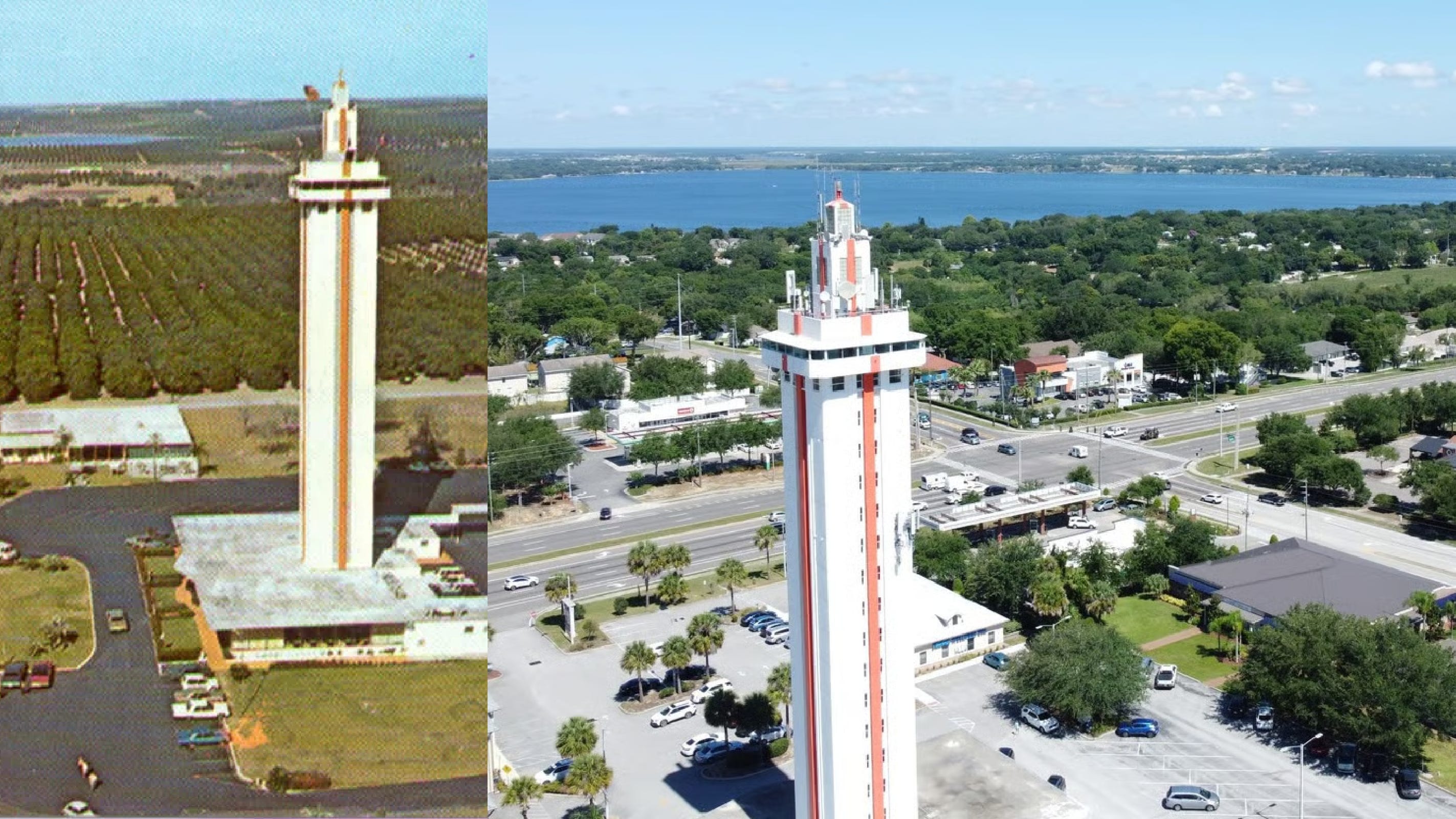
By the time the roadway network all fills in, it takes at least 16 times the roads to serve the bigger store.
But what about frequency? A big WalMart trip doesn’t happen as often as a local grocery pop-in, so that looks like the economy of scale is working for us too.
But maybe not.
You could do 4 weekly grocery trips and drive the same number of miles as one WalMart trip. Every mile traveled isn’t just congestion. It’s wear and tear, and every inch of those roads has to be maintained by the community.
Hmm…this isn’t working quite like we thought. That’s ok, right, because the bigger property gets more taxes?
Well, yes and no.
A 250,000 square foot WalMart or Target has a little over twice as much value as a 90,000 square foot grocery. Sixteen times the roadway miles and maintenance costs. Only double the revenue. That’s a guaranteed red balance sheet.
This happens all across the community in nearly every type of land use. When we look at the taxes, property values increase with size, but not nearly as fast as obligations. Bigger is not better. Four quarter acre home lots will get more tax value than one 1-acre lot—with very few exceptions. Four quarter acre duplexes will get you even more. Which one costs the local government more to serve? From a roadway standpoint there is no comparison. The quantities end up working out about the same as the retail example. In terms of other utilities, the mismatch isn’t quite as stark, but it’s still not good.
Communities realize too late that they have bitten off far more than they can chew. The bankruptcy of Detroit was not an outlier. It was a harbinger. (Strong Towns has just created a Finance Decoder that can find these problems before they become unfixable.)
Increasing maintenance costs mean some projects get put off and that lowers the value of the properties even more. Once the community realizes the problem, they can’t afford to raise taxes to cover the shortfall. That will drive people away and drop property values—which will not help their bottom line.
And here is where an unlikely disruptor can shift the economics.
Enter the Lowly Bicycle.
Walkable, bikable communities get a huge property value bonus for at least a half mile around each functional trail system…
But wait! There’s more!
If you lean in and try to make walking and biking work as a functional part of the transportation system, the feedback loops reverse.
To make walking or biking work, you need to have places to go within biking range of your homes. That means you allow local neighborhood retail to scatter throughout the residential areas. The smaller footprints mean smaller catchment areas that keep trips close to home. This drop in scale also helps local stores compete with delivery services (like Amazon) based on relationships rather than volume or price. You start building accidental communities and third places where neighbors build acquaintance level relationships—and it’s those out-of-the-house relationships that create resiliency in crisis, improve health outcomes, and decimate loneliness.
These smaller shops don’t need as much parking, so it’s a lot easier to get to them—they takes up less space—making it even easier to bike to. Even if those trips don’t shift to biking, they’re a lot shorter.
The freight vehicles you need to serve them are smaller, which means less damage to the pavement—another win.
The change in lifestyle means developers are attracted to build even more in the area—and new development has a lot higher property value than old development. All the orphan parcels that were too big for a house but too small for much else turn into the most valuable parcels in the area.
Is it really that simple?
This is not pie in the sky. This is a proven model that builds real economic value for both the community and the people who live and develop within it. I’ve seen it happen here, where I live. My home is double the value it was when we bought it—about the time that our downtown bike-mecca streetscape finished. Property values in the region have grown, but not nearly as much as ours.
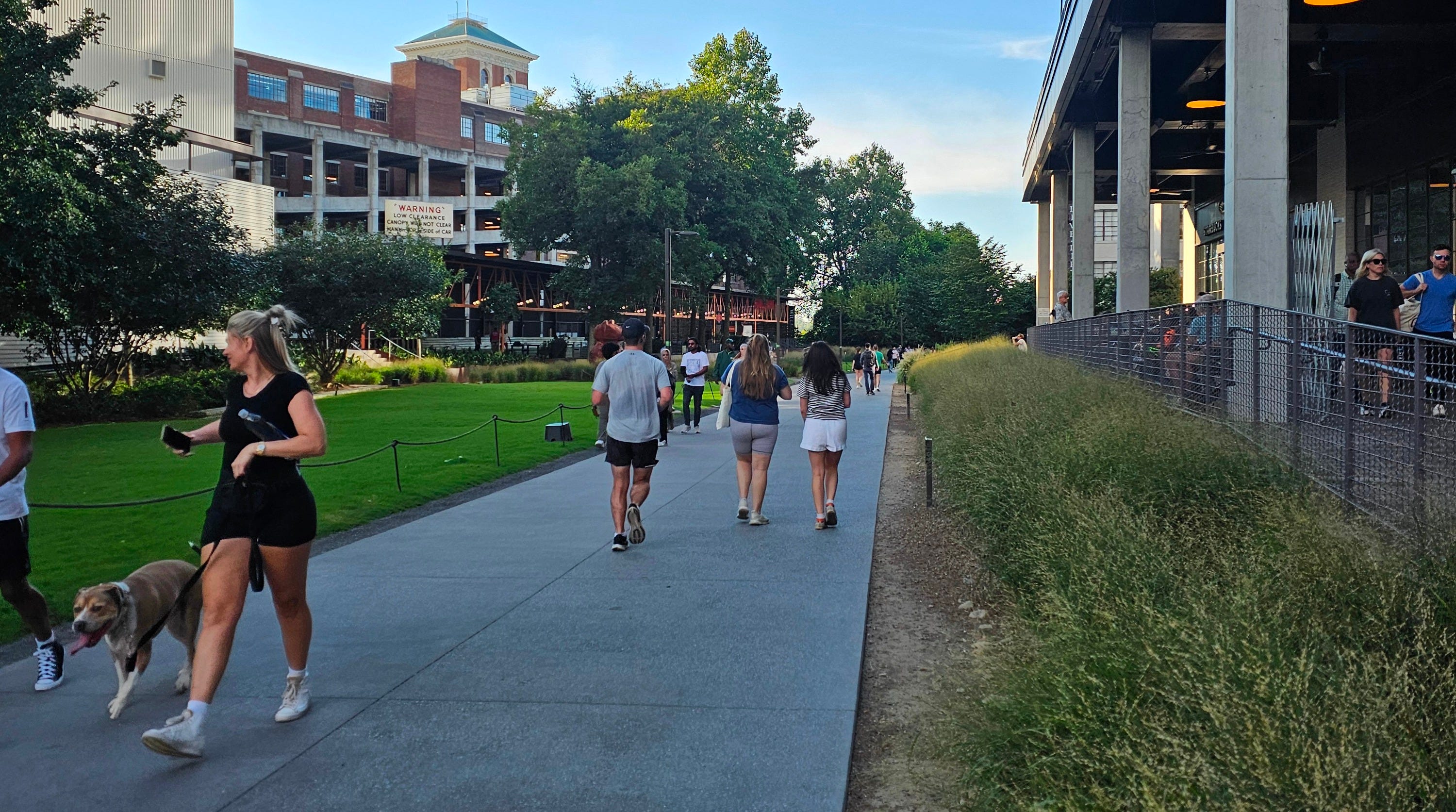
The 22 mile Atlanta Beltline Loop is blowing up value everywhere it touches. Horizon West, between where I live and the Magic Mouse, has not done a good job on keeping the land use mix resolution it was designed to have, but the fact that everything is connected up with bike trails means that people use them anyway—even when it’s not ideal, it still works.
Ironically it was Henry Ford who said:
“Whether you think you can, or you think you can't—you're right.”
If you believe you can create a place where people interact face to face, you will make choices that bring that future into your present.
Up Next:
So it looks like it’s going to take me longer than I like to do video. I’m not quitting, but that series will just have to come out monthly or so until I get better at this. As you can see, I’m putting audio on these—and will try to make audio (good, bad, or ugly) for each one. Hopefully, that will feed into an audio-only podcast at least.
The next few months are going to get very busy—so I may do short updates here and there instead of longer posts, or at least I’m going to try.
If you’re in New Hampshire, I’ll be speaking in April at the ACEC NH/NHDOT Technical Transfer Conference. And it looks like I will be making it to CNU-34 in Arkansas in May. I’ll take suggestions on which venue to pick!!
And no, I didn't miss the irony of using the machine to get a summary. Im drowning in reading!!!
I haven't, but I got the Machine to give me a quick summary and it sounds very similar. I suspect, this week's Jesus Geeks post will hit this topic, but from a very different angle. I was planning to write a book this year looking at the overlap between these two blogs in the same vein as Kingsnorth, but Im wondering if I need to write the book that covers the psychological approach to transportation first.